

Wacky Why's
Why Do First Impressions Matter in Children's Spaces?
November 19, 2026
You walk into a restaurant. The lighting is harsh, the furniture looks like it hasn't been updated since 1987, and you're not entirely sure where you're supposed to stand. You haven't even seen a menu yet, but you're already questioning your dinner plans.
Now picture a restaurant with a warm atmosphere, an inviting entrance, and a little personality. You're already looking forward to your meal.
Same situation. Two very different expectations.
People are surprisingly quick to form opinions about places they've never visited. We pick up on all sorts of little clues, from the lighting and layout to the colors on the walls, and use them to decide what kind of experience we're in for.
For children, who often have very little idea of what awaits them in an unfamiliar place, those first few moments can be especially important.
Wait... Is That a Giant Tree?
Imagine being five years old and walking into a new children's ministry for the first time.
You don't know the teachers. You don't know the other kids. You're not entirely sure why Mom and Dad are leaving you here.
But wait... is that a giant tree? Does it have a slide coming out of it?
Suddenly, there's something much more interesting to think about.
An unexpected feature, a friendly character, or a colorful scene can give children something to focus on besides the uncertainty of a new experience. It might even turn a little nervousness into curiosity.
The same idea applies to pediatric offices, libraries, recreation centers, and other places where children might be unsure of what awaits them.
Of course, not every child responds the same way. Some will run toward the giant tree without hesitation, while others might prefer to admire it from a safe distance.
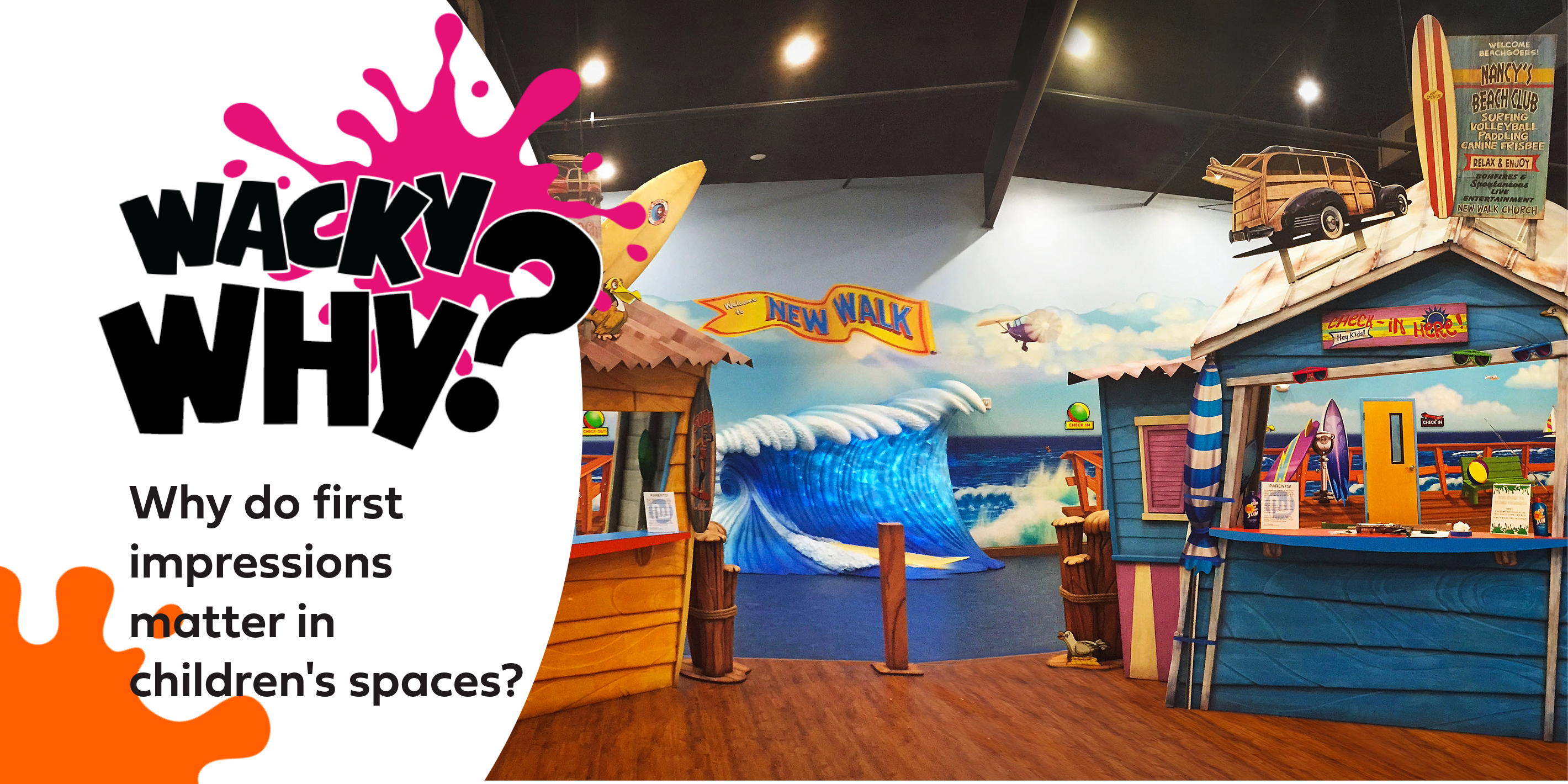
Image suggestion: A children's ministry entrance featuring a large sculpted tree, themed gateway, or another unexpected feature that would immediately capture a child's attention.
Your Brain is Already Making Assumptions
People often don't wait until they've experienced everything a place has to offer before deciding what they think about it.
Our brains are constantly collecting clues and making predictions. Sometimes those predictions are surprisingly accurate. Other times, not so much.
Psychologists call one of these tendencies the halo effect. It's when a positive impression of one characteristic influences how we judge other characteristics.
For example, imagine walking into a children's healthcare facility and finding an underwater world filled with colorful fish, sculpted coral, and friendly sea creatures.
You might start thinking, "Wow, they really went out of their way to make this place comfortable for kids."
From there, it's not much of a leap to assume the staff will be equally attentive to children's needs.
Whether that assumption is accurate remains to be seen, but the environment has already influenced your expectations before the appointment even begins.
If These Walls Could Talk...
If these walls could talk, what would they say?
Hopefully something more interesting than "Please take a number and have a seat."
Every environment sends a message, even when nobody intended it to.
A children's ministry filled with imaginative scenes might suggest that learning about faith is an adventure. A library with a towering storybook tree invites children to explore the world of books. A pediatric office with friendly characters and playful details suggests that someone understands a doctor's visit might be a little intimidating.
Sometimes the message is more practical. Clear signage makes it easier to find the right classroom. A welcoming check-in area can make an unfamiliar process feel less confusing. A mural that continues down a hallway might tempt a curious child to see what's around the corner.
The walls may not actually talk, but they can certainly make an introduction.
The Care You See Shapes the Care You Expect
Imagine visiting a children's ministry where the entrance looks like a forest, complete with sculpted trees, woodland creatures, and a path leading toward the classrooms.
You might start wondering what the rest of the children's programming looks like.
If this much effort went into the entrance, what kind of creativity goes into the lessons? What do the classrooms look like? What else is waiting around the corner?
That curiosity can be a powerful thing.
Of course, there's a catch. The rest of the experience needs to live up to the introduction.
A spectacular entrance followed by a frustrating check-in process is a little like watching an amazing movie trailer only to discover that all the good scenes were in the preview.
Nobody wants to be disappointed by the feature presentation.
Where Should You Start?
Of course, not every organization has the budget to transform an entire building at once. When funds are limited, deciding where to focus can be just as important as deciding what to create.
An entrance or check-in area is a great place to start.
It's one of the few spaces nearly every visitor encounters, whether they're arriving for the first time or the fiftieth. It's also where many of those early impressions take shape.
A themed entryway, a custom dimensional feature, or even a colorful mural can establish the personality of a space without requiring a complete renovation. A children's ministry might start with an engaging check-in area and add themed classrooms later. A pediatric practice could give its waiting room a fresh look while leaving treatment areas for another phase.
There's something to be said for making the most of the space everyone sees.
A Little Preview of What's to Come
First impressions are funny things. They happen in a matter of moments, often before we've had a chance to learn much about a place at all.
Yet a giant tree, a friendly character, or an unexpected scene can change the way someone approaches an unfamiliar experience. It might give a nervous child something to smile about, make a parent feel more at ease, or simply spark a little curiosity about what's around the corner.
A great first impression gives visitors a reason to look forward to what comes next.
If you can dream it, we can theme it!
This article was co-written with human creatives and AI tools, and the content was checked for clarity and accuracy. Photo/video credits: Wacky World Studios.