

Some of our favorite memories aren't tied to a place. They're tied to the people who shared that place with us.
A family vacation.
A favorite museum.
A playground.
A church event.
A day at the zoo.
When we remember those experiences, we often remember who was with us just as much as where we were.
According to Jamie DeRuyter, Entertainment Design Department Head at Ringling College of Art and Design, that's one of the strengths of immersive environments. They're rarely designed as solitary experiences. Instead, they create opportunities for people to explore, play, learn, and celebrate together.
Course Syllabus
More Than Individual Experiences
Shared Experiences Create Connection
Fun Is More Than Entertainment
A Real-World Example: Creating Opportunities for Connection
Designing for Connection
Why Shared Experiences Matter
Key Takeaways
Watch the Interview
Frequently Asked Questions
- Why are shared experiences so important?
- How can design encourage social interaction?
- Why is fun important in immersive environments?
- Can immersive design help build community?
- Can these principles be applied outside of theme parks?
More Than Individual Experiences
Many spaces are designed to serve individual needs.
An office supports individual work.
A waiting room provides a place to sit.
A hallway moves people from one destination to another.
Immersive environments often have a different purpose.
They create places where people share experiences.
As DeRuyter explains:
"The whole family goes and does a thing together."
Whether guests arrive with family, classmates, friends, or teammates, the environment becomes a backdrop for shared moments that wouldn't happen in quite the same way somewhere else.
Shared Experiences Create Connection
One of the most interesting observations DeRuyter shares is how immersive environments can encourage connections between complete strangers.
He describes watching people who have never met ride an attraction together and celebrate afterward as though they've accomplished something as a team.
"You don't know the person sitting next to you on the ride at all. But you get off of that ride and you're high fiving."
For a brief moment, the shared experience creates a sense of connection.
The same principle can be found outside of theme parks.
Families solve interactive exhibits together.
Children collaborate during imaginative play.
Parents and kids discover environments side by side.
Those shared experiences often become the memories people carry home.
Fun Is More Than Entertainment
When people hear the word "fun," they sometimes assume it's separate from learning, ministry, or personal growth.
DeRuyter challenges that assumption.
He asks a simple question:
"Can we have guests having fun while they're learning about the Constitution?"
The answer, of course, is yes.
Fun isn't the opposite of learning. It can be one of the things that encourages people to participate more fully.
When people enjoy an experience, they're often more willing to explore, ask questions, interact with others, and stay engaged.
Rather than distracting from the message, thoughtfully designed experiences can help reinforce it.
A Real-World Example: Creating Shared Family Experiences
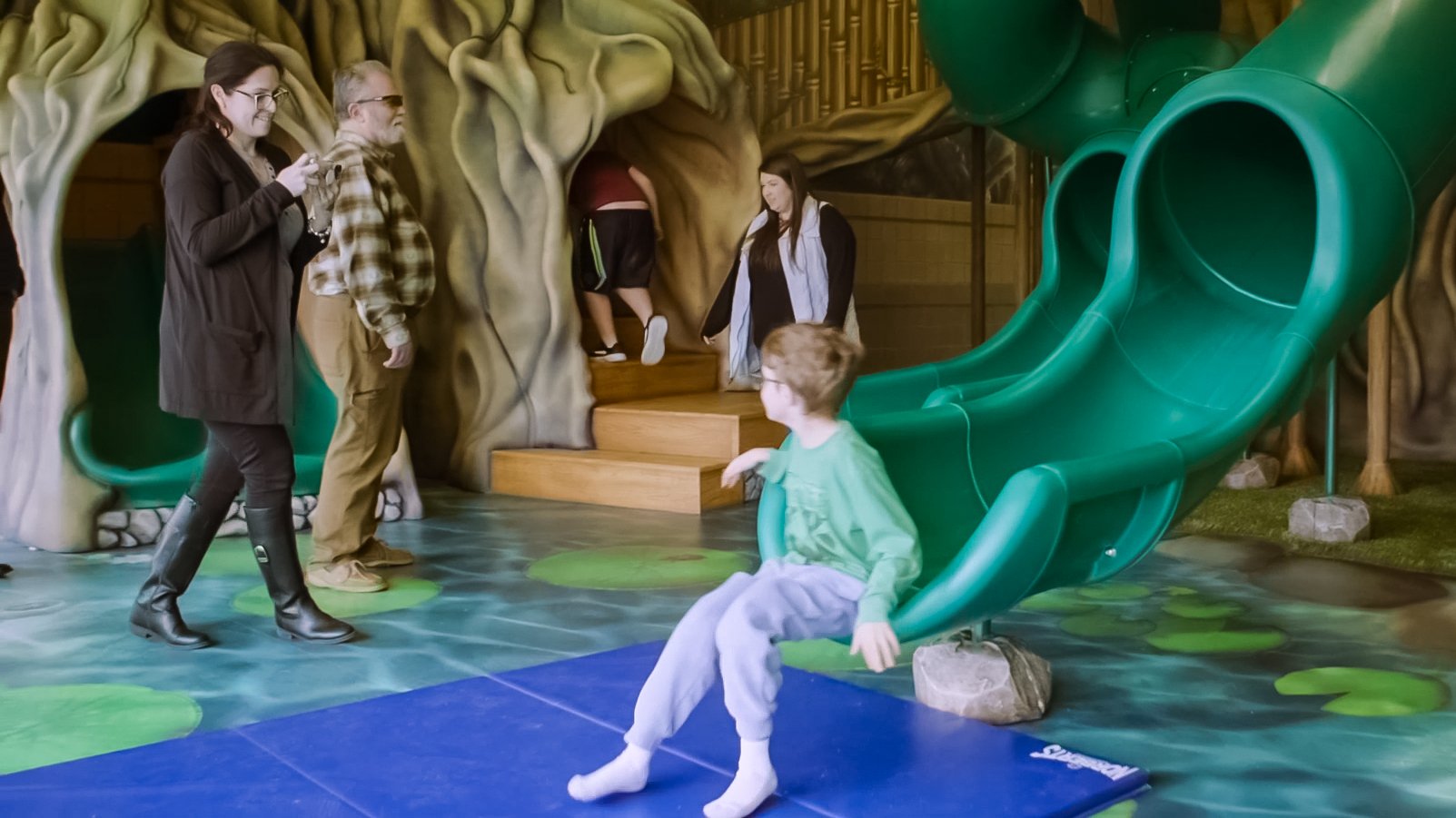
At NewPointe Community Church in Dover, Ohio, the children's ministry environment was designed to encourage more than just imaginative play—it was designed to encourage families to experience it together.
Throughout the space, parents and children explore side by side. Kids climb, discover, and imagine while parents join the experience instead of simply watching from the sidelines. The immersive environment naturally creates opportunities for conversations, laughter, and shared moments that continue beyond a single visit.
Rather than serving as a backdrop, the environment becomes part of the interaction itself.
That's an important distinction.
Thoughtful design doesn't create relationships on its own.
But it can create the conditions where meaningful interactions happen more naturally.
Whether families are exploring a themed play structure, discovering hidden details together, or simply sharing a laugh, those moments often become some of the most memorable parts of the experience.
Designing for Connection
Whether the setting is a church, museum, library, park, school, or community center, immersive environments can encourage people to spend time together in meaningful ways.
Children invite parents to participate.
Friends explore together.
Families create traditions.
Communities gather around shared experiences.
Thoughtful design can't force connection. But it can remove barriers, encourage interaction, and create moments where relationships naturally develop.
Sometimes that's the most meaningful outcome of all.
Why Engagement Matters
As digital experiences continue to become more common, opportunities to gather in physical spaces have become even more valuable.
People increasingly look for experiences they can't replicate through a screen.
They want places where they can laugh together.
Learn together.
Play together.
Celebrate together.
Great environments don't simply create memorable places. They create memorable moments shared with other people.
And those are often the experiences we remember longest.
Key Takeaways
- Immersive environments are often designed as shared experiences.
- Design can encourage positive social interaction and connection.
- Fun can increase participation, engagement, and learning.
- Shared experiences often become lasting memories.
- Great environments create opportunities for people to connect with one another.
Watch the Interview
In this fifth installment of What Themed Entertainment Can Teach Us About Designing Memorable Spaces, Jamie DeRuyter discusses how immersive environments use design, interaction, and environmental cues to encourage engagement and influence behavior.
Frequently Asked Questions
Why are shared experiences important?
Shared experiences strengthen relationships, encourage communication, and create lasting memories between families, friends, classmates, and communities.
How can design encourage social interaction?
Thoughtful layouts, interactive elements, gathering spaces, and immersive environments naturally encourage people to explore and participate together.
Why is fun important in immersive environments?
Fun increases engagement and encourages people to interact more fully with an experience, whether they're learning, playing, or exploring.
Can immersive design help build community?
While design can't create relationships on its own, it can provide opportunities for meaningful interactions and shared experiences.
Can these principles be applied outside of theme parks?
Yes. Churches, schools, museums, libraries, parks, healthcare facilities, and community spaces can all benefit from creating environments that encourage shared experiences.
Stay in the know with Wacky World Studios! We're here to help you with all stages of your theming journey. Make sure you sign up for our monthly newsletter and subscribe to this blog for even more handy theming resources and information. You can also find lots of great inspiration by following us on social media. Our Pinterest and Instagram pages are overflowing with photos and ideas.
And for you DIYers, be sure to check out our online shop at WackyWorldDIY.com.
This article was co-written with human creatives and AI tools, and the content was checked for clarity and accuracy. Photo/video credits: Wacky World Studios, and Abundant Life Church.